
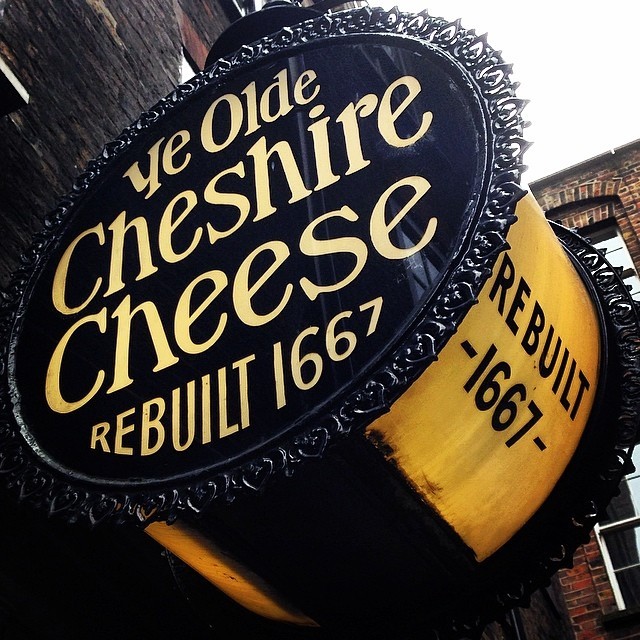
A lunch of fish, chips and a pint in a dark and welcoming ancient pub with burning fireplaces and wood paneling in the center of London… (at Ye Olde Cheshire Cheese)

Springtime in London. (at St Paul’s Cathedral)

Pyramids of small-batch, raw milk cheeses at London’s Neal’s Yard Dairy… (at Borough Market)

A late winter sky over Saint Petri in Copenhagen… (at Skt. Petri)

Tomato and mozzarella… (at Osteria di Brera)

Sunday stroll (at Galleria Vittorio Emanuele II)


I stood at the lake’s edge with several other old Guidas feeding the ducks and geese, pigeons and swans, without regard for any bird hierarchy. Bundled tightly against the imminent rains in Ugg boots and dull colored down coats wrapped over their house dresses, they squinted across Italy’s Lake Como trying to decipher the mountains on the opposite shores. The weather had changed quickly, as it often does in the mountains; the morning’s brilliant blue skies, dotted with wispy white clouds hanging above Switzerland’s snow-capped peaks are quickly obscured by thick fog and heavy gray skies.
The lake is still except for the occasional ferry shuttling day-trippers to this little town of Bellagio for rich coffee and a panini of thinly-sliced Parma ham and earthy mountain cheese. Cold, wet and decidedly off-season, there are few shops and restaurants open; even the locals have shuttered themselves in against the impending rains. Smoke rises from the hills as farmers make haste to burn old vines and leaves before the wet weather douses their fires. Succulents sprout from crevices in ancient stonewalls to binge on the showers. The only sounds are the ducks’ menacing laughter and the hum of far-off chain saws, preparing wood from aged piles for the hearth.
The tiny road along the lake was created for horse and carriage rides, not automobiles. Such reality doesn’t seem to bother Italian drivers, their cars hurtling at full speed in the lane’s center. I tried to school several carloads of Italians with my lusty hand gestures and screamed expletives in English, which I’m hoping translated perfectly.
Lake Como has been a popular destination for the titled, accomplished and wealthy long before George Clooney ever laid his handsome eyes on his villa. Ancient Romans Plinys’ Senior and Junior had homes on the shores, one named Tragedy and the other, Comedy. Leonardo da Vinci incorporated Como’s grandeur into many of his paintings. Verdi, Bellini and Liszt composed music here and writers Shelley, Wordsworth and Stendhal found inspiration on these shores. Longfellow penned the ode to Lake Como: “I ask myself, Is this a dream? / Will it vanish into air? / Is there a land of such supreme and perfect beauty anywhere?”
In addition to its natural splendidness, Lake Como is revered for its fine silk; the silkworm will only produce silk when it eats mulberries, which are native to Italy, and the lakes and alpine streams provide ample water for silk production. The little shops in the villages surrounding the lake hock ties, scarves and blouses in the vivid colors for which Italians are known.
Famished, I ambled up the steep stone, manicured alleyways to the center of town, silent in winter, and took a seat in a small 19th century café on the lake. In halting English, the raven-haired waitress insisted I eat the locally revered dish, pizzoccheri alla Valtellina. Lake Como is tucked into Italy’s northern Lombardy region, known for its high-quality buckwheat, a peasant food as it grows freely in the mountains and is easily milled into decent flour. A bowl of dark buckwheat noodles, flecked with black grain and cooked until just al dente was set before me. It was studded with hunks of boiled potatoes and cabbage cooked in sage butter and laden with the rustic mountain cheese Valtellina Casera. I ordered an inexpensive bottle of Sassella made from Chiavennasca grapes, the local name for Nebbiolo. I slowly devoured every bite of the toothsome pasta and drained all but one glass of the hearty wine, the last of which I saved for the young stud in the kitchen who hand-cut my noodles. As I sipped a local Amaro, dense with flavors of alpine, I overheard the maître d describing Lake Como to a table of German tourists: cultura del bello, the culture of beauty.

Dessert for dinner. (at Bellagio, Italy)
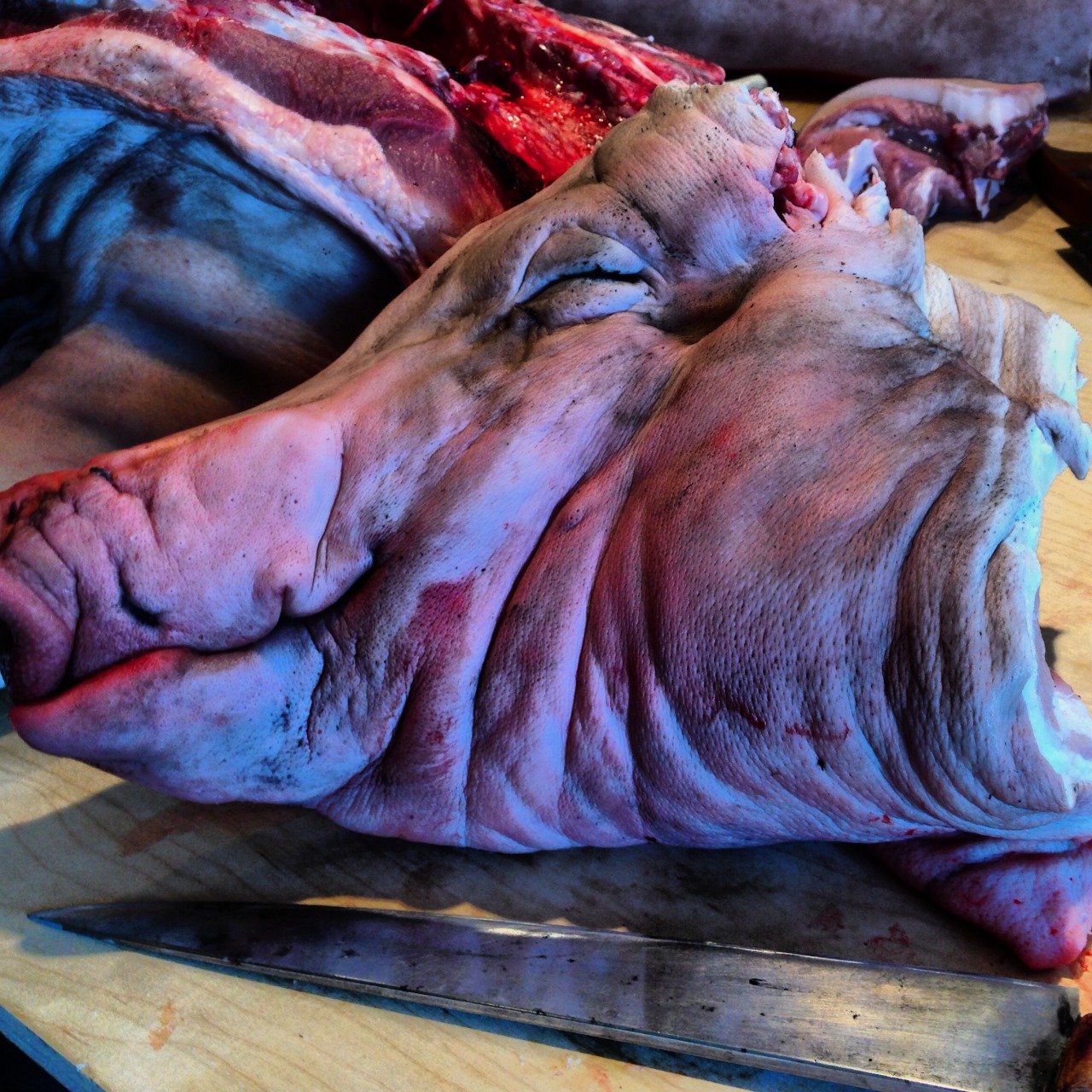
A hair before sunrise found me shivering in the heavy, damp cold of early morning at a tidy farm in the vine-covered hills above Napa Valley.
My pig already chosen for me, One-Shot John put her down quickly; quietly, even. Captain of the last mobile slaughter unit in Sonoma and well deserving of his humane moniker, One-Shot John services small farms in northern California. His custom-built truck of doom negates the need for cows, sheep, goats and pigs to be herded long distances to a slaughterhouse, which causes great stress to the animal; a tragedy for both soulful beast and its meat. While putting stress on a vine produces exceptional wine grapes, the same cannot be said for the pig’s pork loin, the cow’s hanger steak, or the lamb’s rib rack.
One-Shot John washed the porcine’s 250-pound body in a large, mobile tub and shaved her clean; the skin pinkish and glistening. Hoisting the massive girth over his shoulders, he strung up the beast on an old iron gambrel, steam rising from thick haunches now aglow in the first rays of sunrise.
Cursing my decision to wear a sweater instead of one of my many bedraggled sweatshirts, I busied myself collecting the pig’s blood for boudin noir, bagging the heart and liver for frying, and crudely rinsing the endless rope of intestine for sausage.
Before the sun had even shown its warmth to the valley before us, the pig was eviscerated, cleaned, and split in half. She hung for two days in the farmer’s walk-in refrigerator, amidst iron baskets overflowing with green and blue-hued eggs laid by fancy, heirloom chickens, and flats of just-picked lettuces, their ruffled leaves begging to be nibbled naked.
While the pig aged in the chiller, we prepared for the days of work ahead. Spices were purchased from a tiny, specialty shop in Berkeley, its hippie vibe exemplified by the braless chick with dreads who weighed out my first-rate peppers, powders, and seeds. The casings were packed in salt and shipped from upstate New York. Our knives and cleavers were honed on Japanese stones of varying textures, and plywood boards were bleached and laid on top of the marble kitchen island where we’d butcher. A thick stack of clean towels was at the ready and the cool of the porch would serve as refrigeration.
Both enormous halves of the beast, now solidified from the cold, traveled from farm to table in my butchering partner’s white Lexus SUV. We started early and finished late, studying porcine butchering charts, and pouring over blood and grease-spattered cookbooks for spice mixtures, weighing out ingredients on an ancient scale. We listened to bluegrass, drank green tea and smoked hash. But mostly, we butchered; fingers numbed from the frigid meat, we barely made out the muscled edges of each cut. Measure twice, cut once. My antique meat saw, with its fine walnut handle, was outvoted in favor of an electric hand-held, its whirring noise and splattering of bone shards disconcerting.
Roasts, ribs, and loins were vacuum-sealed and labeled. Bones, ears, trotters and tails were kept for stock and soup. Chunks of pork and fat were separated and bagged for making sausage later in the winter. The belly and cheeks were slathered with spices and curing salt to rest for a couple of weeks before being hung to dry, alongside the two thick hind legs. Heartbroken in prior years by mysterious cases of ravaging molds, or from a heavy-handed salting, we decided to once again attempt to create the perfect prosciutto-style ham, a year plus in the making.
My feet hurt and my arms ached. The floor was greasy and flecked with pieces of meat and bone. I glanced down at my bloodied apron and flashed on the thick-necked butchers I’d seen in New York’s Little Italy, who’d step outside for a smoke and gawk at women on their lunch breaks.
After scouring most of the grime from the kitchen, we wearily sat and enjoyed the fruits of our labors. Bitter greens from the garden were wilted with garlic and fresh pork fat. Finger-sized slices of pork loin were quickly fried in a hot pan and dressed with nothing more than flaky salt. The cork was pulled from a 1990 Barolo, its dusty rose and cranberry acid a perfect foil to the richness of the farm fresh meat.

My beloved Radicchio plants. Their progress in the garden is slow, stealthy. The shocking hues of the long, bitter fronds burst forth unexpectedly; yet another overnight sensation that takes a lifetime to achieve. (at at home in Napa)


“Pass me a knife and I’ll cut it out,” Peter whispered, a fringed hippy bag dangling from his waist. His eyes were scrunched maniacally into narrow slits and fixed on a spot in the dirt in front of him, as if he’d lose sight of his prey.
Huffing and puffing from the steep climb through a brambly trail, effects from the morning’s intake of green tea and green bud long subsided, I reached into my basket and handed him my old, Spanish, carbon steel knife. With a few slow, deliberate passes of the blade, he liberated his masterpiece, wiping away the leaves and dirt with a small brush.
“Voila! A fine example of the Bothends mushroom… ‘cause if you eat it, it’ll be coming out of both ends,” chuckled Peter.
Thus began my mushroom foraging tutorial.
A mild, sunny January morning provided for an exemplary hike in the hills above Point Reyes. Unfortunately, the too-dry northern California winter has done little to encourage the fruiting of mushroom spores, which thrive in moist environments. Fungi typically grow in soil above ground, or live vampirically off their host food. Their queer appearance and quicksilver growth are only two of the many reasons mushrooms have always been warily regarded; the Devil’s fruit, with gills and fairy rings open doors into magic portals. And, indeed, many doors have been opened from mushrooms containing psychoactive properties. For thousands of years, in various cultures, the magic mushroom has been worshipped. Murals in the Sahara desert dating to 9,000 BC suggest psilocybin mushroom trips. Religious ceremonies in 4000 BC Spain celebrated its alchemy; the Mayans perfected the journey.
More recently, a study conducted at John Hopkins University confirmed previous assertions that mystical experiences brought on by mushrooms are equal to non-drug induced mystical experiences in both content and long-term effect. In a follow-up to the study, more than half of the participants rated their psychedelic trip among the most significant spiritual experiences of their lives, with a continued sense of well-being and life satisfaction. I can only imagine the one-third of the subjects who experienced extreme, short-lived anxiety after ingesting the hallucinogen are probably not people with whom I’d want to sup in any state.
But I’d break bread with our lead forager Patrick in a heartbeat; a tall and lanky geek with encyclopedic knowledge, a scruffy beard and dirty knit cap, he embodied the hippie vibe so often found with American mycophagists (those who forage for edibles). A self-described Mychochef, he’d pluck an ugly, slimy mushroom from the ground, rattle off both its scientific and common name, its edibility and quality rating, and then offer up a quick recipe, complete with cooking instructions and wine suggestion.
The undisputed meat of the vegetable world, fungi are foraged and given a place of honor at tables around the globe. They are a good source of B vitamins and essential minerals, and when not swimming in butter and white wine, are a mere 20 calories per ounce. Mushrooms boast a long list of medicinal uses and they’re even being transformed into eco-happy construction materials.
Dream house and hallucinations aside, it was the dark, earthy flavors of winter for which I now fantasized; standing in thick socks in front of the stove, wooden spoon in hand, I would relentlessly stir the risotto in a dinged copper pot while bathed in steamy aromas of shallot, pheasant stock, salted Norman butter, and several hearty splashes of oxidized California Chard. It would be finished with mountains of shaved Reggiano and handfuls of sliced chanterelles, their orange heads poking up through a blanket of glistening Arborio. Or perhaps tomorrow I’d make a late morning breakfast: eggs and cream whipped to a froth and just barely cooked, papered with thin slices of porcini mushrooms shaved on my ancient tin mandolin, and finished with florescent thyme leaves, flaky sea salt, and a drizzle of green Tuscan oil.
I get hot just thinking about it.
But none of that deliciousness was to come to pass. We found very few edibles of lesser quality, which made for more learning opportunity and less proper meal. I’m not yet knowledgeable enough to hunt mushrooms without a mentor, my ignorance in identifying various species threatening the lives of my dinner guests. Too many mushrooms are liver-meltingly poisonous and often resemble the edible species. There is no defining characteristic shared by all poisonous mushrooms – except their toxicity, which cannot be identified by merely eyeballing the fungi in question.
You have to know your shit.
My foraging quest ended a week later in front of a table at a farmer’s market, manned by three gruff Asian ladies, the oldest of whom most certainly knows her shit. On offer were both wild and Sonoma-farmed mushrooms splayed out in large boxes. I greedily picked the largest hunks of Miatakes, easily filling a paper bag. Also known as Hen-of-the-Woods or Sheep’s Head, their spherical shape is covered in whitish fronds that tickle the tongue. Cooked slowly in a cast iron skillet with young onion, butter, generous splashes of a yellowed Alsatian Pinot Gris, and a palmful of thyme and sage, the thick centers of the Miatakes brown while their ruffled fronds crisp. Topped with a poached egg at lunch or a shaving of Parmesan at supper, the mushroom’s tellurian flavors of forest floor, the essence of winter’s darkness, sustain.

Afternoon tea and shortbread delivered to a sunny, quiet nook; a favorite indulgence.

Low tide this afternoon on a peaceful Tomales Bay. (at Marshall Beach)

The sweetly heady, slightly fetid scent of the Narcissus flower heralds early winter…

Winter citrus. (at at home in Napa)

I stood at the sink in pajamas, my tattered white linen nightdress and leopard-print flannel pants already doused with grimy remnants of the ocean’s floor. The shitty oyster glove was nothing more than cheap rubber, which I’d already manage to puncture a handful of times. Literally. I was petrified I was going to jab a hole straight through my hand each time the knife slipped from the oyster’s hinge.
But I was determined.
These were special.
Earlier this morning, we bundled up and drove to California’s coast, stopping only for nettle tea and sesame cookies in the hip-hick town of Point Reyes. We pushed further northwards to tiny, movie-set perfect Marshall, set against the rugged beauty of Tomales Bay, a backdrop of pine-covered mountains framing the entire plein air.
We were announced by the crunch of oyster shells under tire as we pulled into the miniscule parking lot of Hog Island Oyster Company, its low slung, blue and white buildings jutting into the calm waters, the warm midday sun fortifying us against the chill of late November. A myriad of picnic tables were occupied with weekend revelers, many with large plastic tumblers of cheap Sonoma wine in hand. Swirling smoke dissipated in the sunlight, leaving behind scents of charred wood from the grilling oysters.
As we stood in line at the pick-up window, having phoned our order weeks ahead, I contemplated the oyster farm fanned out in front of me. The aroma of the bay’s low tide suggesting otherwise, the waters are relatively clean. Bivalves, including clams and oysters, are known as ‘filter feeders’, and consume plankton and other detritus from the waters, each oyster capable of filtering 50 gallons of water per day. Tomales Bay’s native oyster presence, now cultivated for more than a century, means cleaner waters with a more diverse ecosystem in which the oysters thrive for at least one full year until they’re mature.
But it wasn’t just any ol’ oyster for which we’d traveled.
Once a year, twice if incredibly fortunate, Bélon oysters are harvested in Tomales Bay. Actually, to call them Bélon is akin to referring to California sparking wine as Champagne. Bélon oysters are from the Bélon River in Brittany, France and boast their own AOC classification. So revered is this body of water that oysters harvested from other parts of France are taken to this river and finished there. Affinage, the French call it. The same species of the Bélon oyster, Ostrea edulis, is commonly known as the European Flat oyster. (Mais Bélon est tellement plus sexy, non?) Native to Europe, Flats are now farmed in both California and Maine, with extremely small productions. With a flatter, wider and more delicate shell than other oysters, they’re more reminiscent of the scallops we dug for on Nantucket in the winter.
Flats have a very tight shallow cup with little space for the oyster to grow, and they’re often shipped with a band around the shell to keep them closed, so not to lose a precious drop of their lovely liquor.
This is not to imply they are sweet.
There’s nothing delicate about Flats in the least. These oysters are thin, almost crunchy, and the flavors that linger long are deeply of this earth: minerals, salt, seaweed, metal. Jolting.
The platter was finally readied, a bed of ice slowly melting underneath a shucked baker’s dozen of these special bivalves. Horseradish root had been finely shaved onto a small wooden board, and green Meyer lemons from the tree behind the porch were sliced in half. An old Raveneau Chablis I’d been hoarding was chilled and decanted, thick pieces of dark rye were toasting, and my hand had finally stopped bleeding.
Dinner is served.

Wrapped warmly in cowboy hats, fur coats and leather pants, my ten fellow passengers and I disembarked our small plane in Bozeman, Montana. We were greeted by a crystal clear, ice-cold morning a few days before Thanksgiving. The taxidermy we passed on the way to baggage claim, proudly exhibited throughout the tiny airport, presciently foreshadowed my trip.
A friend with whom I hunt bird in northern California invited me to spend the holiday hunting in Montana. His family, living just outside of Bozeman and hunters all, gathered me at the airport and hosted me in their comfortable Arts and Crafts bungalow. My host, a large Labrador Retriever of a man, had driven out from Napa Valley and allowed me to load his car with my traveling booty, bypassing the hassle at airport screening sure to be brought on by my ‘contraband’: a case of mature California and French wines, washed-rind cheeses, Japanese and Chinese teas, Meyer lemons, Mendocino green bud, Maldon salt, shotguns in their leather scabbards, butchering and hunting knives, and several different types of ammunition.
After fetching me at the airport, our small group drove for an hour through Montana’s breathtaking vastness of hills and plains, observing its big sky, and listening to the wail of country music from the local radio station. The sporting life is woven into people’s daily routine; into the understanding of their position and their role within nature. I spotted a white SUV, one side covered in dried blood. Being of Italian descent from the east coast, and having spent a chunk of time in southern Italy, I just assumed it was a Mafia hit. It was patiently explained to me that a deer or elk had been put on the roof rack and had bled down the side of the car and frozen there.
We arrived at media mogul Ted Turner’s ranch just after noon. The Flying D is an 113,613-acre ranch located in southwest Montana just north of Yellowstone National Park. Like all Turner ranches, the Flying D is operated as a working business, relying on bison and hunting as its principal enterprises. Two handsome cowboys, both of whom were sporting dreamy chaps, Stetson hats and thick drawls, greeted our group. We loaded into an old jeep equipped with a wench hung on its open trailer. Even at midday under a sunny sky, it was biting cold. We were after a bison. About 500 heads a year are culled from Turner’s ranch by sporting enthusiasts and those wanting to fill their freezers for the winter ahead. These enormous beasts are ear-tagged with varying colors depending upon their size. The ‘harvesters’, to which we are referred, pay a fee determined by the size classification of the desired animal. We drove through the hills until we came upon one of the many roaming herds. My host, a fantastic shot, used a bow and arrow to quickly put down the 800-pound animal, considered a mid-sized bison.
The cowboys immediately got to work, expertly eviscerating the bison and leaving its astonishingly enormous, steaming entrails for the hawks and ravens circling overhead. They strung up the animal by its front legs on the wench and drove us back to our car, unceremoniously depositing our harvest, hide and head intact, into our waiting trailer.
We had hours of work ahead of us and only a few of remaining sunlight. We rigged a pulley to the old barn, located on the property where we were staying, and hoisted that huge, heavy beast off the ground. We began by sharpening our knives and carefully skinning the bison. After several hours of slowly cutting and peeling back the skin, a pile of black hairy hide lay beneath the still-warm carcass. The sun had dropped behind the mountains across the valley. Despite the warmth of the flesh, my hands were frozen, my fingers stinging from the cold. Nature would provide the evening’s necessary refrigeration.
Over a fine dinner of roasted pork loin, smoked chipotles, and a 1985 Mondavi Cabernet, we discussed how Americans, carnivores to the core, hold strong, often vehement reactions to hunting. We debated our country’s collective disconnect to the meat on our table and how that meat is actually raised. I have always been a passionate cook, devoted to the notion of seasonality and locality, which provided my initial incentive to hunt. My hosts were anxious for me to bag my first game: a white-tailed deer. Having only pursued birds, I was curious about my gut reaction to killing a larger animal. But as I nestled under soft flannel sheets, listening to the frigid wind howl, I concocted a recipe for a future venison stew.
Not uncommon in hunting circles, we rose before dawn. I brewed an enormous pot of Jasmine Pearl tea with Meyer lemons and good Montanan honey to wake and warm us while we butchered the bison. The enormity of the creature was only realized as we dressed the immense loin, the strapping legs, the barrel-like chest. It was hours of laborious work, made less tedious by the freshness of the animal and the sun’s slow ascent, warming the frozen, peaceful valley spread out at eye-level before us.
Having cut and wrapped most of the meat to be shipped home, we piled into a spacious pick-up truck, complete with requisite gun racks, hunting dogs and antler sheds, and headed into the mountains to hunt bird. I felt like a teenager: drinking beer, gnawing on homemade jerky and listening to old rock-n-roll at high decibels. It was bone-chillingly cold, but the big sky was bright blue. We hiked the open fields for hours, the crimson corn and wheat stubble yielding few opportunities to shoot but plenty of amazing vistas. Just before sunset, we stumbled upon a covey of Huns, or Hungarian partridge, and bagged just a small one.
As we arrived back to the house, I noticed a pile of birds lying on the porch. I sorted through pheasant, partridge and quail; their colorful bodies frozen solid from the outdoor temperatures. We walked inside the house, warmed from the constantly stoked fireplace, as an enormous cast iron skillet was being removed from the oven and the cork pulled from an older Williams Selyem Sonoma Coast Pinot Noir. A wild pheasant pie with foraged mushrooms was to be enjoyed for dinner, its savory aromas making me wild with anticipation.
Early Thanksgiving Day, I rose before the sun, layered up and met my hunting partners. The three of us hiked to an enormous valley at the base of a mountain range, its peaks topped by snow. It was beyond cold. I was deeply chilled and already wondering how I was going to maneuver my frozen fingers into pulling a trigger. The wheat field was crunchy beneath our feet, but it had not yet snowed. As the light grew, it slowly warmed me, defrosting my purple hands. The only sounds were cows moaning in some far-off pasture. We didn’t hike for long before we noiselessly crept into a dried-up riverbed. Peering into the next field, we spotted a five-point buck. God, he was beautiful. It was so quiet and peaceful. I was in a reverie.
The shot ripped through my dreams. I was unprepared. It seemed so inappropriately loud. Its violent noise ricocheted endlessly off the surrounding mountain ranges. The buck went down quickly, soundlessly. Behind him, we were surprised to see a yearling doe, once hidden by the larger buck, staring straight at us. The bullet went through her tiny neck and she collapsed immediately. Bittersweet.
The final vision I have of my Montana Thanksgiving is watching my two bundled hunting partners drag the eviscerated deer, steam rising from the opened bodies, across the frozen valley as the sun slowly rose from the mountains behind them. The rugged beauty of that landscape remains with me.
I returned from Montana on Thanksgiving afternoon. My ‘big feast’ consisted of salsa and chips and two iced-cold Belgian ales at the Bozeman Airport. I sat and looked out over the planes to a not-so-distant mountain range. I felt so tired and dirty. I desired nothing more than a huge salad to counteract all of that Montanan meat, and a hot oily bath to warm my chilled bones and clean the distinct scent of butchering from my chapped skin.
A few days after I returned home, my bison meat and whole doe arrived to my front porch in northern California. In the days ahead, along with a couple of friends, I would process much of the bison into beautiful fresh sausages for winter suppers. But I wanted a different experience for the doe. I put on Coltrane and lit all the candles in my little kitchen. I sharpened my knives and shooed the cats into the next room. I placed the deer on my dining table. I had already skinned and cleaned her under Montana’s big sky. A yearling, she was so small; more reminiscent of a large dog. I butchered her slowly, carefully, taking care not to leave one trace of the prized, sacrificial meat behind. Her bones were later roasted and used to make a dense, glistening stock. I recalled my hunting partners telling me young doe are hugely revered for their tender, sweet meat. I cut two slices from the strikingly red loin and seared them off to rare in a smoking hot cast iron skillet. The meat tasted minerally, like a fine French wine. With a little sea salt and a glass of Araujo Cabernet, it was quite rich and decadent; a feast worthy of my deep thanksgiving.

Late-autumn still life. (at at home in Napa)
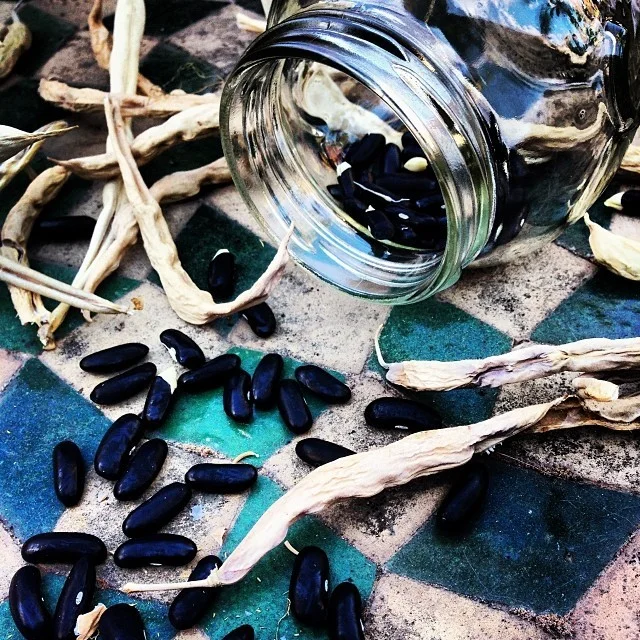
Harvesting French bean seeds from their dried pods to plant in the spring. Time to plant the chicories and escarole for our winter soups…

He was tight for an old man, his wetsuit molding a chiseled body still glistening from a midday free dive in the cove below. Barefooted, he trudged up a quiet lane lined with stands of cypress trees bowed and sculpted by the constant wind off the rugged Mendocino coast. He crossed the yard towards his home, a 1960s California ranch crafted from redwood planks, now weathered a New England grey from the salty air. I drove by him very slowly, nervous and unsure of how to approach him.
Earlier that day, predawn found us shivering on a fishing boat, our mugs of Jasmine tea long gone cold. The captain, a middle-aged townie who knew the seas, had a wad of tobacco stuffed in the side his mouth, and turned frequently to spit off the back of the boat. With proper Lost Coast hospitality, we were encouraged to use the coffee maker in the galley, loaded with finely ground beans from Thanksgiving Coffee, the local roaster, and to share in the generous stash of Mendocino’s finest green bud. Trailed by flocks of gulls and the occasional pelican, our boat slowly made its way out of the dark harbor and up along the northern California coast in search of halibut. As the sky brightened and the sun rose, we sunk chunky weights with half a mackerel each as bait from our poles; my fingers frozen a shade of purple-blue and stinking of the acrid, oily bait. The ocean’s swell was just enough to keep me slightly nauseated, but the waters were placid. For several hours, we bounced the lures into sandy shoals on the sea’s bottom where halibut feed.
Or may have fed at some point in the distant past.
In truth, the local fishermen warned me that there was little, if any, halibut to be had. We were too far south, and it was late in the season. But I had a special dinner for which to prepare; the pheasants had already been bagged and brined, and my heart was set on starting the meal with a plate of freshly caught halibut sashimi with grated Oregon wasabi and a drizzle of good, green California oil. But no halibut were to be hauled into the boat. Not even a shimmery salmon, a rather common fish. Perhaps I should have blamed the morning’s lack of success on my fisher-mate. A long-time vegetarian, she later told me that she took one look at the skipper’s heavy iron fish priest and said a silent prayer we wouldn’t have to use it.
I was chilled and tired and the fish coolers were empty as we packed out of our sweet rented cottage hidden in the Mendocino redwoods. I perked up, however, when I spied the shapely old man walking up the street from the beach, a sack hanging heavy off his back.
“You drink red wine, sir?”
And thus began my negotiation for wild abalone.
With northern California’s strong tides, sneak waves and rip currents, as well as low visibility in the kelp beds favored by both abalone and great white sharks, harvesting wild abalone is not for the faint of heart. Considered a marine snail, abalone can only be taken by free diving (without scuba equipment) or by rock picking at low tide. Highly regulated by Fish and Game, the harvest is limited exclusively to red abalone, while strict law protects black, white, pink, and flat varieties. Between April and November, anyone with a California fishing license can pull abalone from the waters north of San Francisco Bay, but they must measure 7” across, with a limit of three per day, maxing out at 24 per year. And while it’s commercially farmed in central California, it is against the law for abalone harvested in the wild to be sold.
On any given weekend during harvest season, dozens of small boats, kayaks and inner tubes bob gently in small coves dotting the coastline, while below the surface, free divers use abalone irons to pry the snail away from rocks, usually at depths of 5-35 feet. Abalone are encased in extremely hard, pearly iridescent shells, often used as ashtrays on the picnic tables of stoners, or hung as badges of honor on garage doors.
I have plenty of ashtrays. It was the meat I craved.
We followed the old man into his home; padding over the plastic sheeting his wife had lain to protect the wall-to-wall carpet from his frequent beach forays. As trade, I set two bottles of good Barolo on the redwood kitchen counter; remains from the case I lugged along for our fishing holiday. In turn, he handed me a bag containing the meat of one large abalone. I danced across the sheeting and out the heavy wooden door, hung proudly with a gleaming abalone shell.
Once home, I began cleaning the ugly beast. Abalone is 1/3 edible meat, 1/3 offal, and 1/3 shell. As the old man had already done the heavy lifting of both harvesting the abalone and prying the meat from its carapace, I trimmed away the viscera and the hard, dark edges and scrubbed it clean. With an enormous wooden mallet and a thick cutting board, I tenderized the tough snail until flat and smooth to the touch, my arm aching from the exertion.
Eggs were whipped with cream and pepper, and fine Italian flour was sifted and seasoned with fresh oregano and chilies. Salted Sicilian capers had been soaking for several hours, and were ready to be fried. The abalone filets were dredged and laid to rest in a cast iron skillet, hot with bubbling butter. Once browned on both sides, I moved them to a warm plate and hit the pan with yet more butter, the juice of green Meyer lemons, a heavy-handed splash of an oxidized Chardonnay, and the rinsed capers. I spooned the goodness over the crisped abalone filets and served them on small plates accompanied by large goblets of flaxen Chablis; the brininess from both wine and snail in perfect harmony.